How Restoran Volaria in Veruda marina runs reservations at the height of the season without a book on the bar
A 130-seat restaurant on Veruda marina in Pula, a kitchen open from noon to 10 p.m. and Saturdays with several hundred meals. What Volaria uses instead of a paper reservation book, and what another restaurant can take from it.
Restoran Volaria sits right on the shore of Veruda marina, at Cesta Prekomorskih brigada 12 in Pula, about ten minutes' drive from the centre. It has 130 seats, a large terrace looking out on the masts and a kitchen open from noon to 10 p.m. Since 2021 it has been run by a new team: owner Igor Prhat and chef Ante Živković, who turned the menu towards fresh fish, shellfish and pasta made in the kitchen every day. On Saturday evenings, according to the guide to Pula's restaurants, the house serves several hundred meals. That many tables, guests off boats and phone calls in the middle of service do not fit in a book on the bar, which is why Volaria runs its reservations through the jelo.hr system.
Where the reservation book breaks
A paper book works while the restaurant is half empty. In July, when the phone rings while a waiter is carrying four plates, what goes into it is a name without a mobile number, two tables for the same slot, or nothing, because the call was taken by someone who meant to write it down later. A guest with a confirmed reservation then waits at the entrance while a free table is looked for, and staff cannot tell whether the mistake is in the handwriting or in the arrangement. Every such case in season costs a table that could have been sold twice.
What Volaria uses
Through jelo.hr, Volaria uses four things that work together:
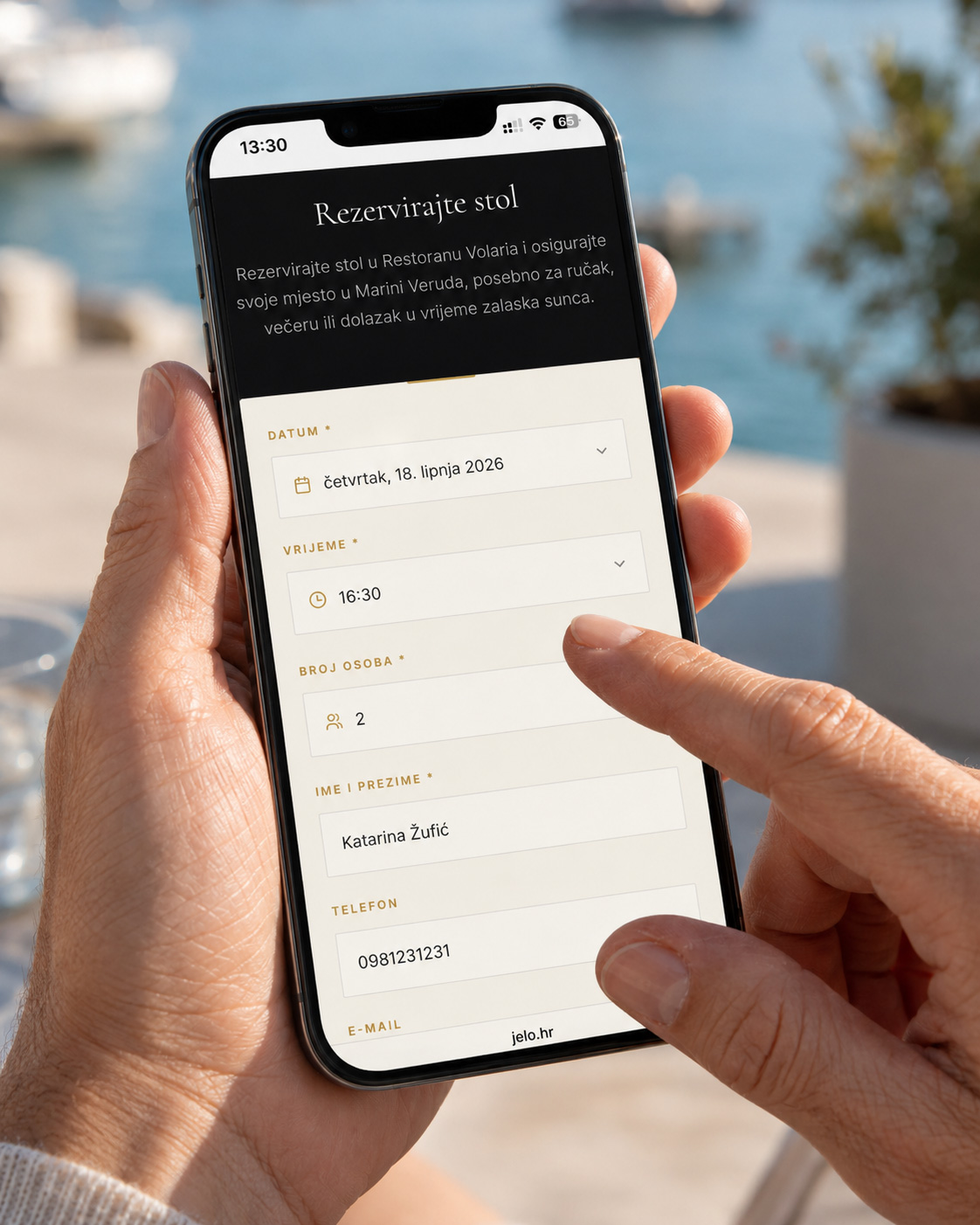
- Online reservations. The guest picks a date, time and party size on the restaurant's website or profile, at any hour, including when the restaurant is closed. Before confirming, the system checks free tables, so the same table is never booked twice, and if the requested slot is taken it offers up to three nearest alternatives. Phone reservations are entered by staff into the same system, so there is one list regardless of channel.
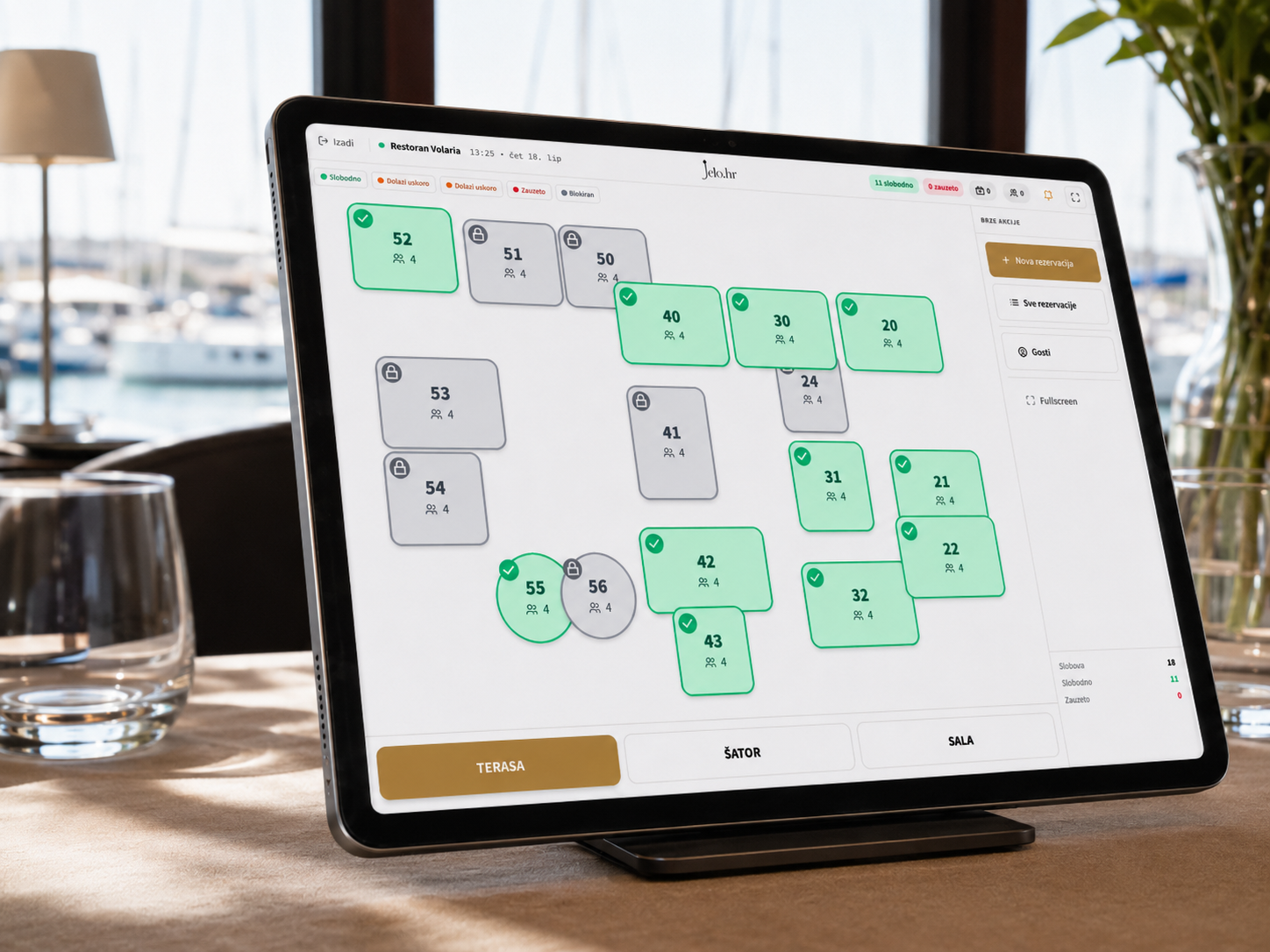
- Table layout. The terrace and the dining room are separate zones with real tables, their capacity and priority. Every reservation has a duration and a turnaround time between two parties, so the system knows when a table is free again. Tables can be blocked by date and hour for private events.
- Automatic notifications. The guest receives an e-mail confirmation with the reservation details and a reminder the day before, and staff are notified of every new reservation the moment it arrives.
- Staff on a tablet. Waiters have the list of upcoming reservations on the tablet with name, table and notes, and mark the guest's arrival, without access to prices and settings in the admin area.
Volaria's mobile reservation is also the example jelo.hr shows on its online reservations page, so you can see exactly what the guest is holding in their hand.
Saturday at 8 p.m., step by step
- At 3 p.m. a guest from a boat in the marina books a table for six at 8 p.m. from their phone. The system checks which tables for six on the terrace are free in that slot, taking into account the duration of reservations before and after, and assigns the table with the highest priority.
- Guest and restaurant receive an e-mail confirmation at the same moment; the reservation appears on the tablet in the dining room.
- At 7.45 p.m. the waiter sees on the tablet that a party of six arrives in five minutes and that the note says high chair. The table is already set.
- When the family sits down, the waiter marks the guest as arrived. The list of upcoming reservations stays clean, and the visit is written into the guest's profile for next time.
What does not happen: nobody interrupts service to say on the phone that there is no room, nobody copies from one book into another, and nobody hunts for a table for a guest who insists they called on Tuesday.
What another restaurant can take from it
Volaria's way of working is not tied to fish or to a marina. In practice, three settings decide whether the system will work in another venue too:
- Reservation duration by table size. A table for two and a table for eight do not last the same. Set the duration realistically according to your own service, because it decides how many times the system will sell the same table in an evening.
- Table priority. The system fills higher-priority tables first and smaller tables before larger ones, so a couple does not end up at a table for six at 8 p.m.
- Marking arrival. Staff mark the arrival when the guest actually sits down, not when the reservation comes in. That way the list of upcoming reservations shows what is still to come.
Setup takes a day: the system is connected within 24 hours, works on a computer, tablet or phone and needs no additional equipment.
What it costs
The Pro+ plan, which includes a physical tablet configured for the venue, staff access and priority support, costs 79 € a month. The Pro plan without the tablet is 59 €, and Start with online reservations and a basic table layout is 29 € a month. Activation is paid once, 99 €, and includes system setup, the website, reservation configuration and e-mail notifications; each additional website language is 25 €. There is no fee per guest or per reservation, which for a restaurant serving several hundred meals on a Saturday is the difference from portals that charge per seated guest, such as TheFork and OpenTable. For comparison, DISH Professional Reservation costs 25 € a month excluding VAT plus a one-off fee of 50 € (dish.co, September 2026), without a tablet or staff access.
All plans and what each includes are on the pricing page. If you would like to see how the table layout and reservations would look with your terrace and your dining rooms, get in touch via the contact page.