A reservation system without a per-guest fee: what a reservation really costs
Two billing models on the market: a fixed subscription or a fee for every seated guest. The maths at 300, 600 and 1,000 guests a month, public prices with sources, and when each model makes sense for your restaurant.
Restaurant reservation systems are billed in one of two ways. The first is a fixed monthly subscription: the same amount in January and in August. The second is a fee for every seated guest, known in the trade as a cover fee, usually charged on reservations that arrive through the provider's marketplace rather than from your own website. Under the second model the bill grows exactly when business is good.
This is not an attack on per-guest fees. They also pay for the traffic the marketplace brings you, and that is legitimate. The aim is for you to see the yearly figure, because most owners never add it up.
Who charges what in September 2026
Public price lists, checked on 10 September 2026:
- TheFork Manager: reservations arriving through TheFork and partner channels carry a fee expressed as a percentage of your average bill per guest; reservations from your own website, Instagram and Facebook are included without commission. The exact percentage is not published and pricing is on request (theforkmanager.com/en-gb/pricing).
- OpenTable: a subscription plus a fee per seated guest for reservations from its network. We could not confirm the amounts for Croatia on the public page, so we do not quote them.
- DISH Reservation (Metro): fixed, in Croatia €25 per month plus a one-time €50 activation, excluding VAT (dish.co/HR/hr).
- Eat App: fixed, the Lite plan at $69 per month billed annually or $99 monthly; Core $159 or $199 (restaurant.eatapp.co/pricing).
- jelo.hr: fixed, Start €29, Pro €59 or Pro+ €79 per month, plus a one-time €99 activation, nothing per guest or per reservation.
What a per-guest bill looks like: a worked example
Since providers with per-guest fees do not publish the amount, we take an assumed €1 per seated guest. This is an illustration, not a price list; put your actual quote in place of that euro. The figures apply only to guests who arrived through the provider's marketplace, not to every guest in the restaurant.
- 300 guests a month via the marketplace: €300 a month, €3,600 a year, before any subscription.
- 600 guests a month: €600 a month, €7,200 a year.
- 1,000 guests a month: €1,000 a month, €12,000 a year.
A thousand guests a month through one channel is not out of reach for a restaurant running at full capacity in summer: that is 33 guests a day. If the provider also charges a subscription, add it to every line. If the fee is €2 instead of €1, double everything.
What a fixed bill looks like
With a fixed subscription you know the yearly cost in advance, at 100 guests and at 1,000:
- DISH Reservation: 12 × €25 = €300 a year, €350 in the first year with activation.
- Eat App Lite: 12 × $69 = $828 a year, billed annually.
- jelo.hr Start: 12 × €29 = €348 a year, €447 in the first year with activation.
- jelo.hr Pro: 12 × €59 = €708 a year, €807 in the first year with activation.
- jelo.hr Pro+: 12 × €79 = €948 a year, €1,047 in the first year with activation.
Comparing the same restaurant with 600 marketplace guests a month: the assumed per-guest model costs €7,200 a year, jelo.hr Pro €708. A difference of roughly €6,500 is an order of magnitude, not a detail, and it stays that way even if you halve the per-guest fee.
For the other side of the ledger, jelo.hr's pricing page uses a simple measure: if the average reservation brings in €50, two reservations a month are €100 of revenue, more than the Pro plan costs. Everything above that is margin that stays with you.
What you are actually paying for with a per-guest fee
Here we have to be fair. A per-guest fee is not just a software charge; part of it pays for traffic from the provider's marketplace. When a guest opens the app, types "fish restaurant nearby" and books with you, the provider brought you a guest you might not have had. That has value.
The question is how many of those guests come because of the marketplace, and how many are your existing guests who simply clicked the nearest button. If the guest was coming to you anyway, the fee on them is a cost with no new value. A practical test: in your regular-guest database, check how many marketplace reservations belong to guests who have been to you before. If that share is large, you are paying an intermediary for traffic you created yourself.
When each model makes sense
A per-guest fee makes sense if you are a new restaurant without a guest base, if you work in a city where guests genuinely pick restaurants through an app, or if every extra guest brings a margin that comfortably absorbs the intermediary. Then it is a marketing cost, and should be booked as one.
A fixed subscription makes sense if you have guests who come back, if most reservations arrive from your website, Google or word of mouth, and if you want the cost not to grow with success. It also brings a predictable budget, which in hospitality, where everything else changes every month, is worth something on its own.
The part not in the maths: whose guests are they
With a fee-based marketplace the guest is their user first and your guest second, and the guest database lives with them. The Quandoo shutdown showed this literally: new reservations stop on 30 September 2026, and after 31 December 2026 the website, app and infrastructure are switched off (quandoo.de/important-update). Restaurants that kept their guest base only there must export it before that date. The order of moves is in the guide Quandoo is shutting down: deadlines and a five-step plan.

What you get for a fixed price on jelo.hr
- Online reservations 24 hours a day with a free-table check and up to three alternative times offered
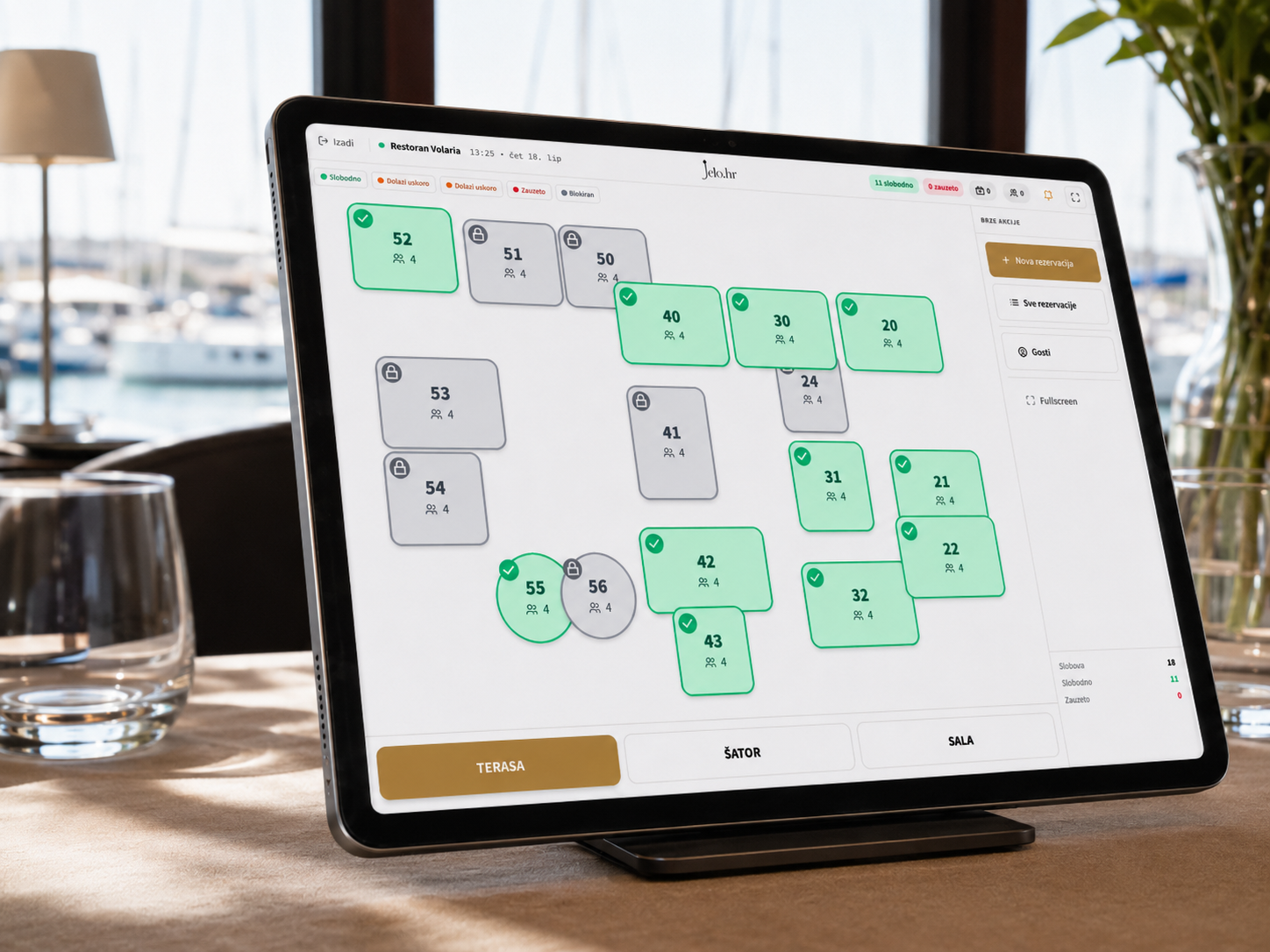
- Table plan by zone, with per-table capacities and blocking by date
- Automatic notifications: confirmation to the guest immediately, reminder the day before, alert to staff
- Regular guests with visit counts, notes and preferences (Pro and Pro+)
- Loyalty programme tied to your restaurant, with rewards after a set number of visits
- Digital menu in four languages, reachable by QR code on the table
- Restaurant website with reservations, on your own domain if you have one
- Staff access with limited permissions
- Analytics of reservations and visits by day (Pro and Pro+)
The subscription has a six-month minimum term, the €99 activation covers setup, the website, reservation configuration, email notifications and one language, and each additional language costs €25. Before deciding you can use all Pro functions free for seven days, no card required.
What the fixed price does not include: the guest visibility jelo.hr adds is on the Jelo restaurant map in Croatia, so it does not replace traffic from a German or Italian marketplace. The full plan overview is on the pricing page, and if you want the maths done with your guest numbers and your average bill, get in touch through the contact page.